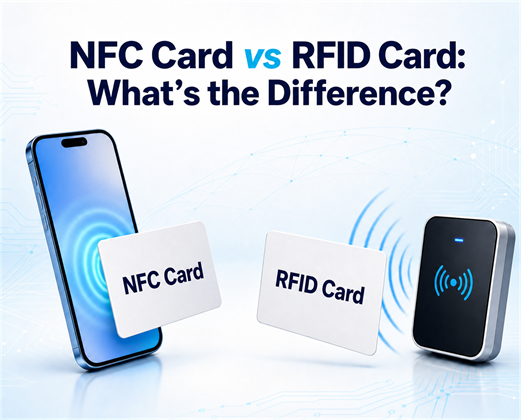
Contactless technology has become an essential part of modern business operations. From employee access control and public transportation to inventory tracking and mobile payments, smart cards help organizations improve efficiency while delivering a better user experience. During the selection process, however, many buyers encounter two similar terms—NFC cards and RFID cards—and assume they refer to the same thing.
While NFC and RFID are closely related, they serve different purposes. RFID is a broad family of wireless identification technologies used across industries, whereas NFC is a specialized subset of High Frequency RFID focused on secure, short-range communication with smartphones and other consumer devices. Understanding the differences helps businesses choose the right solution, avoid compatibility issues, and build systems that scale.
RFID (Radio Frequency Identification) is a wireless technology that uses radio waves to identify objects and exchange data between a tag (or card) and a reader. A typical RFID card contains a microchip and an antenna embedded in plastic. When the card enters the reader's electromagnetic field, data is transmitted without physical contact, making the process fast and reliable.
One of RFID's greatest strengths is its flexibility. Different RFID systems operate on different frequency bands, each optimized for specific communication distances and environments:
Frequency Band | Typical Frequency | Read Range | Data Transfer | Common Applications |
LF (Low Frequency) | 125 kHz | A few centimeters | Slow, read-only in many cases | Door access, animal tagging, vehicle immobilizers |
HF (High Frequency) | 13.56 MHz | Up to ~1 meter | Moderate speed, supports encryption | Payment cards, library books, transit tickets, NFC |
UHF (Ultra High Frequency) | 860–960 MHz | Up to 10+ meters (passive) | Fast, bulk reading | Warehousing, logistics, supply chain, retail inventory |
NFC (Near Field Communication) is a specialized branch of HF RFID operating at 13.56 MHz, defined by the ISO/IEC 18092 and ISO/IEC 14443 standards. Instead of supporting long-range identification, NFC is designed for secure communication over a very short distance—typically within a few centimeters—requiring the two devices to be brought close together intentionally.
The biggest advantage of NFC is native smartphone compatibility. Most modern mobile phones have built-in NFC readers, allowing users to tap an NFC card to open a URL, share contact details, make a payment, connect to Wi-Fi, or verify a product. This convenience has made NFC cards the preferred choice for digital business cards, contactless payments, loyalty programs, hotel key cards, product authentication, and interactive marketing.
Key point: All NFC cards use HF RFID at 13.56 MHz, but not all HF RFID cards are NFC-compatible. Only cards that follow NFC Forum specifications (such as ISO/IEC 14443 Type A/B with NDEF data support) can be read by smartphones out of the box.
Feature | NFC Card | HF RFID Card | LF / UHF RFID Card |
Technology | Subset of HF RFID (ISO/IEC 18092, 14443) | HF RFID (ISO/IEC 14443, 15693, etc.) | LF (125 kHz) or UHF (860–960 MHz) |
Frequency | 13.56 MHz | 13.56 MHz | 125 kHz / 860–960 MHz |
Read Range | A few centimeters | A few cm to ~1 m | LF: a few cm; UHF: up to 10+ m |
Smartphone Compatibility | Yes (native on most modern phones) | Only NFC-compliant variants; ISO 15693 often requires specific apps | No (requires dedicated readers) |
Read Method | One-to-one, intentional tap | One-to-one or small batches | UHF supports bulk reading of dozens of tags |
Data Transfer | Moderate speed, two-way | Moderate speed | Fast (UHF); slow (LF) |
Typical Use Cases | Payments, digital business cards, marketing, access, loyalty | Transit, library, event tickets, access control | Access (LF); warehousing, logistics, asset tracking (UHF) |
The most noticeable difference is communication distance. RFID systems span everything from a few centimeters (LF) to over ten meters (passive UHF), enabling readers to identify multiple tags quickly without direct line of sight. This makes UHF RFID particularly effective in warehouses, manufacturing lines, and logistics hubs where speed and automation matter.
NFC, by comparison, operates within a few centimeters. Rather than being a limitation, this close-range requirement is a deliberate security design: data exchange only occurs when the user intentionally places the card (or phone) near the reader, reducing the risk of eavesdropping or accidental activation.
A common misconception: NFC read distance is not a fixed "4 to 10 cm." It usually works within a few centimeters, although the actual reading distance depends on the chip, antenna size and design, reader power, and surrounding materials. Metal surfaces, for example, can detune the antenna and reduce range to under 1 cm unless the card uses an anti-metal layer.
The reading method also differs. UHF RFID systems can scan dozens or even hundreds of tags simultaneously as goods pass through a portal or conveyor. NFC is strictly one-to-one—a single card communicating with a single device—making it ideal for user-initiated interactions such as tapping to pay or sharing a digital business card.
Compatibility is often the deciding factor when businesses compare NFC with traditional RFID.
Most LF and UHF RFID cards require dedicated readers that support the correct frequency and protocol. These readers are installed in office buildings, factories, warehouses, hospitals, and transportation systems. Because different RFID systems use different standards, a card designed for one system may not work with another—an LF access card will never be read by a UHF warehouse portal.
NFC offers a more familiar consumer experience because modern smartphones function as readers out of the box. Instead of purchasing additional hardware, businesses can let customers or employees interact with NFC cards using devices they already carry. A single tap can open a company website, display contact information, connect to Wi-Fi, launch an app, verify product authenticity, or deliver rich product information.
Important: Not every 13.56 MHz RFID card is automatically compatible with smartphones. Only cards that comply with NFC Forum Tag Type standards (based on ISO/IEC 14443) are readable by the native NFC reader on iOS and Android. Cards using other HF protocols, such as ISO 15693 (often used for library and item-level tagging), typically require specialized third-party apps or readers and may not respond to a standard phone tap.
Security capabilities vary widely across both technologies. Basic LF RFID cards often carry only a unique ID (UID) read by a central database, with no onboard encryption. More advanced HF and UHF chips support mutual authentication, encrypted communication, and anti-cloning features. NFC chips used in payment and identity applications—such as MIFARE DESFire or those implementing NFC Forum secure element standards—include sophisticated cryptographic protection.
Rather than assuming one technology is inherently safer, businesses should evaluate the security features of the specific chip being considered, including encryption algorithm, key management, and whether the UID is programmable or locked at the factory.
Cost is another area where generalizations can mislead. It is true that basic LF proximity cards are among the cheapest contactless credentials available, making them attractive for large-scale deployments such as employee ID badges. However, the cost of a card depends far more on the chip type, memory capacity, security features, materials, printing requirements, and order quantity than on whether it is labeled "NFC" or "RFID."
For example, a simple NTAG213 NFC card (144 bytes memory, no encryption) can cost less than a high-security MIFARE DESFire EV3 RFID access card with 8 KB memory and AES encryption. Conversely, a UHF RFID label for inventory tagging can cost a fraction of either. Hardware costs matter too: in consumer-facing applications, NFC often eliminates or reduces the need for dedicated readers because smartphones handle the interaction, which can lower total deployment cost significantly.
Different applications call for different chips. When sourcing cards, specifying the chip model is just as important as specifying NFC or RFID. Below are widely used chips in the industry:
NXP NTAG213 – 144 bytes, entry-level, ideal for URLs and tags
NXP NTAG215 – 504 bytes, used for Amiibo and richer NDEF records
NXP NTAG216 – 888 bytes, larger memory for vCards and multi-actions
NXP MIFARE Ultralight / EV1 – Lightweight, common for transit tickets
NXP MIFARE Classic 1K/4K – Legacy, widely used for access control
NXP MIFARE DESFire EV2/EV3 – High-security, AES encryption, payments and ID
EM Microelectronic EM4100 / EM4102 – LF 125 kHz, read-only, classic access control
TK4100 – LF 125 kHz, low-cost clone alternative to EM4100
T5577 – LF 125 kHz, writable, programmable for cloning/copying
NXP UCODE 8 / UCODE 9 – UHF, long-range, inventory and supply chain
Impinj Monza R6 / R6-P – UHF, high sensitivity, retail and asset tracking
Alien Higgs/H3 – UHF, widely used for passive tags and labels
AMS/SONOS CODE SLIX – HF ISO 15693, library and item management
A digital business card, for example, may use an NTAG213 or NTAG216, while a secure access card for a corporate building might require MIFARE DESFire EV3. Specifying the chip model upfront avoids compatibility surprises and ensures the card has the right memory and security features for the job.
There is no universally superior option; the right choice depends on the application.
Choose RFID (LF or UHF) when the priority is automation, long-range identification, or large-scale tracking. LF cards remain a cost-effective choice for legacy door access systems. UHF RFID is the standard for warehouse inventory, manufacturing line monitoring, logistics and shipment tracking, and asset management—scenarios where hundreds of items must be identified quickly as they move through a checkpoint.
Choose NFC when the goal is to connect directly with end users through their smartphones. Digital business cards, contactless payments, interactive smart packaging, event ticketing, hotel room keys, visitor registration, loyalty programs, and product authentication all benefit from NFC's tap-to-act simplicity and broad mobile compatibility.
Before finalizing a decision, businesses should evaluate practical factors including: existing reader infrastructure and frequency compatibility, required communication distance, security and encryption needs, memory capacity for data storage, whether the card will be used near metal or outdoors, required durability and card material (PVC, PET, bamboo, etc.), printing and personalization requirements, and plans for future system expansion.
Compatibility note: NFC cannot replace every RFID system. While NFC works with certain HF RFID standards (ISO/IEC 14443), it cannot communicate with LF (125 kHz) or UHF (860–960 MHz) systems commonly found in industrial and logistics environments. If you are upgrading or expanding an existing system, verifying frequency and protocol compatibility is the essential first step.
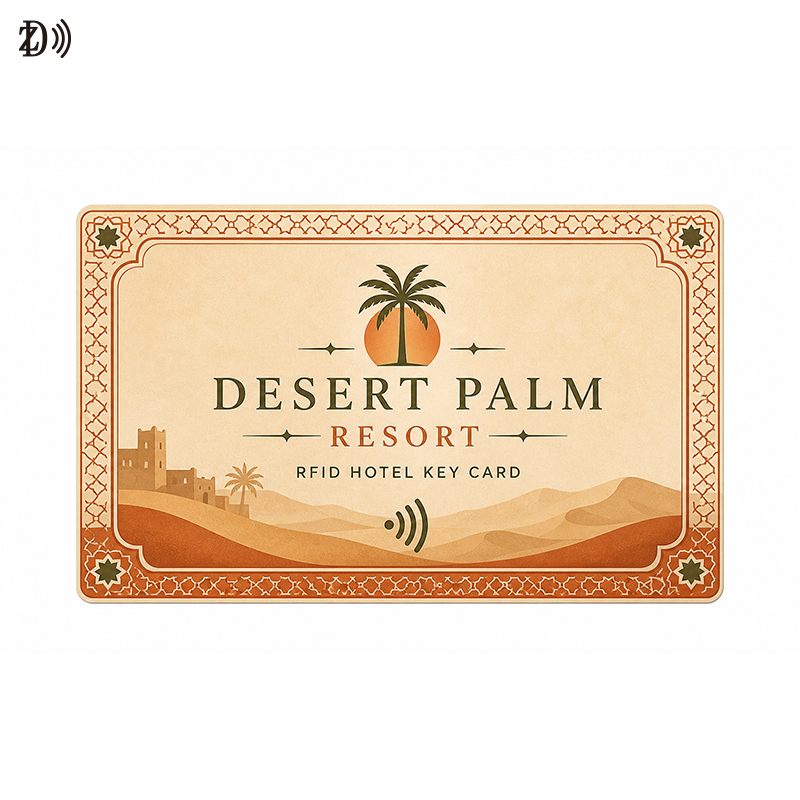
Because frequency, protocol, chip, and form factor all interact, buyers should clarify the following questions with their supplier before placing an order. Missing any one of these can result in cards that do not work with existing hardware or fail to meet project requirements:
What frequency and protocol does your existing reader or terminal support?
Does the card need to be readable by smartphones (i.e., NFC Forum-compliant)?
What reading distance is required for the application?
Do you need read-only cards, or read/write capability for encoding data?
What security features are required—unique UID, password protection, AES encryption, or secure element?
How much user memory is needed (e.g., for a URL, vCard, or application data)?
Will the card be used on or near metal surfaces, outdoors, or in harsh environments?
Do you need card encoding, URL/UID serialization, or database matching services?
Do you require custom printing, variable data (QR codes, names, photos), or special materials?
What is the expected order quantity, and do you need samples for compatibility testing first?
Is an NFC card the same as an RFID card?
No. NFC is a subset of HF RFID technology. Every NFC card uses RFID principles at 13.56 MHz, but many RFID cards operate at LF (125 kHz) or UHF (860–960 MHz), or use HF protocols that are not compatible with NFC smartphones.
Can smartphones read all RFID cards?
No. Most smartphones can only read NFC Forum-compliant HF cards (ISO/IEC 14443 Type A/B, such as NTAG and MIFARE families). LF and UHF RFID cards always require dedicated readers, and even some HF cards using ISO 15693 may not work with native phone readers.
Which technology is better for inventory management?
UHF RFID is generally the best choice for inventory and warehouse management because it supports longer read distances (several meters) and can identify dozens of tags simultaneously, making it far more efficient than NFC or HF for bulk scanning.
Is NFC more secure than RFID?
Security depends on the specific chip, encryption, and key management rather than the technology label. Both NFC and advanced HF/UHF RFID chips can provide strong security when mutual authentication, AES encryption, and UID locking are implemented. Basic read-only cards in either category offer minimal security.
How do I choose between NFC and RFID for my project?
Start with your application. If you need industrial automation, long-range identification, or bulk scanning (warehousing, logistics, manufacturing), choose LF or UHF RFID. If you need smartphone interaction, customer-facing tap experiences, payments, or digital engagement, NFC is the right choice. Always verify frequency and protocol compatibility with existing hardware before ordering.
NFC cards and RFID cards share the same underlying radio frequency principles, but they are engineered to solve different problems. RFID—spanning LF, HF, and UHF bands—provides a flexible platform for identification, automation, and large-scale tracking across industries. NFC, as a specialized HF subset, focuses on secure, close-range communication that integrates naturally with smartphones and consumer devices.
Neither technology is universally better. For logistics, manufacturing, warehouse automation, and legacy access control, LF and UHF RFID remain the workhorses. For organizations looking to enhance customer engagement, enable contactless interactions, or bridge physical products with digital experiences, NFC offers unmatched convenience and accessibility. By matching the frequency, protocol, and chip model to the actual use case—and confirming compatibility with existing infrastructure before ordering—buyers can build systems that perform reliably today and scale efficiently tomorrow.
Do you need a professional team to provide you with solutions? Contact us for a quote
Let us discuss it with you.


 Tel: +86-755-23080267
 Email: [email protected]
Add: A316,building A, Huayuan Technology And Innovation Park, Baoyuan Road
Copyright © 2024 Shenzhen ZD Technology Co., Ltd., All rights reserved.
Designed by