
Many teams face uncertainty when choosing between RFID and NFC. Unclear differences can lead to unsuitable selection, weak reading performance, and inefficient daily use. This guide helps you pick the right option quickly.
RFID (Radio-Frequency Identification) is a broad wireless technology that uses radio waves to identify and track tagged objects. It supports multiple frequency bands and long-range, batch reading for industrial and commercial tracking.
NFC (Near Field Communication) is a subset of RFID that works only at a very close range. It is optimized for smartphone compatibility and secure, short-distance two-way interaction.
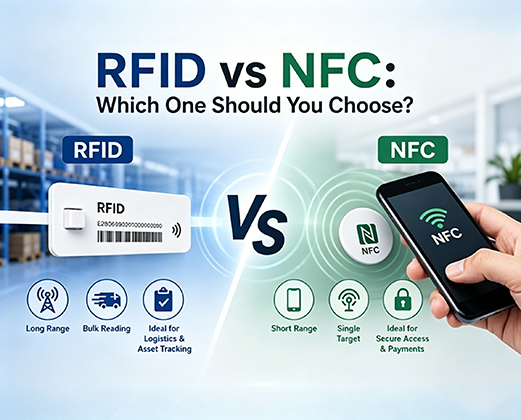
The most obvious difference between RFID and NFC is their working reading range. RFID can support stable long-distance identification up to 10 meters, which makes it highly suitable for industrial tracking and inventory scenarios. NFC only works within 0 to 10 centimetres and requires close tapping, so it is limited to short-range interaction.
RFID and NFC also operate on different frequency bands to serve different purposes. RFID uses multiple bands, including LF, HF, and UHF (860–960 MHz), to adapt to various industrial and commercial environments. NFC works on a fixed high frequency of 13.56 MHz, designed specifically for safe and stable short‑range transmission.
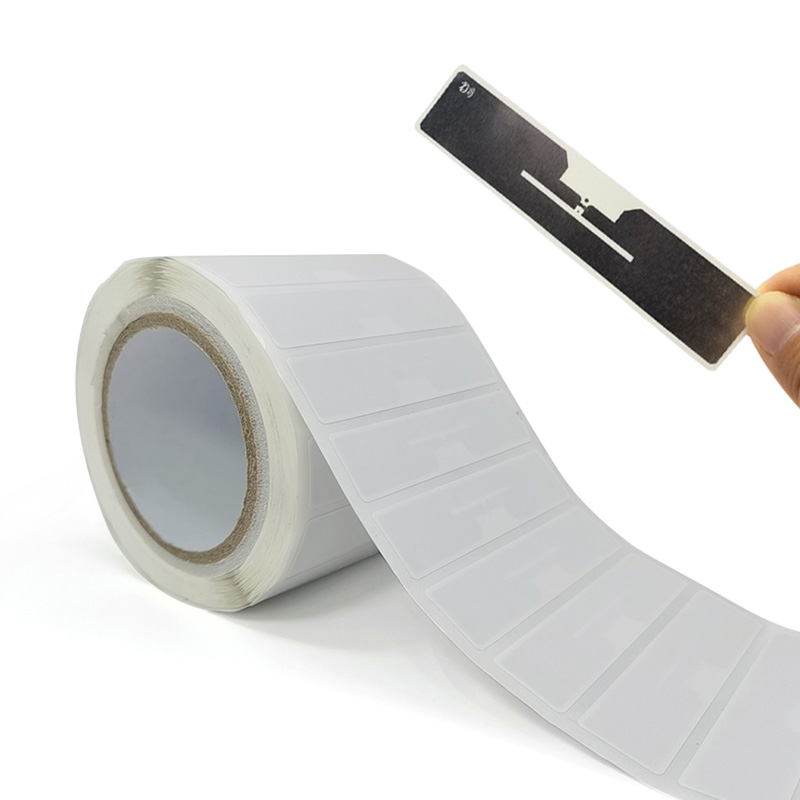
Another key difference is the way they read tags in practical use. RFID supports batch reading of multiple tags at the same time, greatly improving efficiency in warehousing and large-scale management. NFC only allows one-to-one single tag reading, which is more suitable for personal and small‑scale applications.
Device compatibility is one of the most concerning points when comparing RFID and NFC. RFID relies on professional readers to capture and process tag information, which is standard for industrial projects. NFC can be directly recognized by most smartphones and mobile devices, making it more flexible for daily use without extra equipment.
RFID and NFC are different in data transmission and communication modes. RFID mainly provides one-way identification from the reader to the tag, focusing on object tracking and positioning. NFC supports two-way of peer-to-peer communication, enabling safer data interaction for payments, access control, and smart device connection.
Feature | RFID Tags | NFC Tags |
Typical Structure | Passive UHF design, long reading distance, strong anti-interference | 13.56 MHz passive design, optimized for smartphone reading |
Environmental Resistance | Supports anti-metal, waterproof, high-temperature industrial versions | Standard durability for indoor daily use |
Data Storage | Larger storage for assets, inventory, and batch tracking | Small storage for simple commands, URLs, or basic information |
Deployment Cost | Lower unit cost in large batches; needs dedicated readers | Low entry cost; no extra reader (uses smartphones) |
Best For | Industrial tracking, warehousing, retail inventory, and harsh environments | Access control, smart labels, quick tap interactions, and small-scale use |
Opt for RFID when your project requires long-range detection and efficient batch tag reading. This technology excels in large-scale operational scenarios where manual one-by-one checking would waste time and labour resources.
It is the ideal pick for warehouse inventory, retail stock management, and industrial fixed asset tracking. RFID performs reliably even in complex surroundings like metal equipment, liquid storage areas, and outdoor working environments where ordinary short-range solutions fail.
Besides inventory and asset management, RFID also works perfectly for large-event crowd control, logistics parcel sorting, and industrial production line identification. All these scenarios demand stable long-distance performance and the ability to process multiple tags simultaneously.
NFC is the right choice when your scenarios only need close-range connection and simple one-on-one data interaction. It works seamlessly with regular smartphones, so you don’t need to purchase and install dedicated readers as you do for RFID systems.
It is widely applied in daily life and office settings, such as building access control, employee ID verification and community gate entry. Mobile payment, membership card recognition and product smart label inquiry also rely heavily on NFC’s tap-to-connect feature.
For small-scale internal management, casual data sharing between phones and lightweight check-in tasks, NFC is more convenient and cost-effective. It fits all scenarios that prioritize easy operation, low cost and no extra professional hardware.
First, figure out your required reading distance and working mode when deciding between RFID and NFC. If your business relies on long-range detection and batch scanning for inventory or assets, RFID is the more reliable option. If you only need close-range tapping and one-to-one connection in daily use, NFC can satisfy all basic demands.
Second, assess your hardware setup and overall budget for deploying RFID and NFC systems. NFC works well with ordinary smartphones without extra expensive devices, which lowers the entry cost for small scenarios. In comparison, RFID needs dedicated readers and supporting equipment, making it more fit for large and long-term projects.
Then, consider the actual working environment where you will use RFID tags and NFC tags. RFID can maintain stable performance in complex conditions with metal interference, liquid storage or outdoor exposure. NFC is more designed for regular indoor scenes and cannot adapt to harsh industrial surroundings.
Additionally, think about your application scale and future development plans. RFID offers better scalability for warehouse management, logistics sorting and large-scale asset tracking. NFC remains a simple and economical choice for access control, mobile payment and smart label inquiry.
Choosing between RFID and NFC ultimately comes down to your actual application scenarios and budget needs. If you are looking for reliable RFID tags and NFC tags with stable quality and cost-effective pricing, please contact us. We can provide you with tailored solutions to fit your project perfectly.
Do you need a professional team to provide you with solutions? Contact us for a quote
Let us discuss it with you.


 Tel: +86-755-23080267
 Email: [email protected]
Add: A316,building A, Huayuan Technology And Innovation Park, Baoyuan Road
Copyright © 2024 Shenzhen ZD Technology Co., Ltd., All rights reserved.
Designed by 

