
RFID labels, also referred to as smart labels, have become essential in a wide range of industries. They are being increasingly integrated into modern life, facilitating the global transition toward automation, traceability, and smart management. As one of the world’s top ten anti-counterfeiting technologies, the innovation of RFID labels is advancing at a rapid pace. But what makes them so effective—and so widely adopted?
RFID (Radio Frequency Identification) is an advanced identification and tracking technology that utilizes radio waves for contactless data transmission between a reader and a tag.
Similar to barcodes, RFID labels transmit product information. However, unlike barcodes, RFID does not require a line-of-sight connection, and passive RFID labels can support long-distance reading. For a deeper understanding of the differences between RFID and barcodes, you may refer to the article: RFID vs Barcode: What’s the Difference?
RFID labels can be embedded into products of various shapes and made from different materials. Each RFID chip is equipped with a unique ID, which makes duplication extremely difficult and ensures strong security and anti-counterfeiting capabilities.
RFID tags can communicate with readers 50–100 times per second, enabling continuous, real-time tracking. As long as the tagged item is within the reader’s range, its location and status can be monitored instantly.
As soon as an RFID label enters the reader’s magnetic field, data is captured immediately. Moreover, readers can process multiple tags at the same time, allowing for fast batch identification.
A standard barcode can store up to 2,725 digits, and the number of characters it can hold decreases significantly when letters are included. In contrast, RFID labels can store up to 10 KB of data, providing abundant space for detailed product information.
RFID labels can function normally in harsh environments, such as dusty, oily, polluted, or even radioactive settings. Their sealed design ensures a much longer lifespan compared to printed barcodes.
RFID labels do not depend on specific lighting conditions and offer excellent penetration. They support long-distance reading, and active RFID labels (equipped with built-in batteries) can achieve a read range of 30 meters or more.

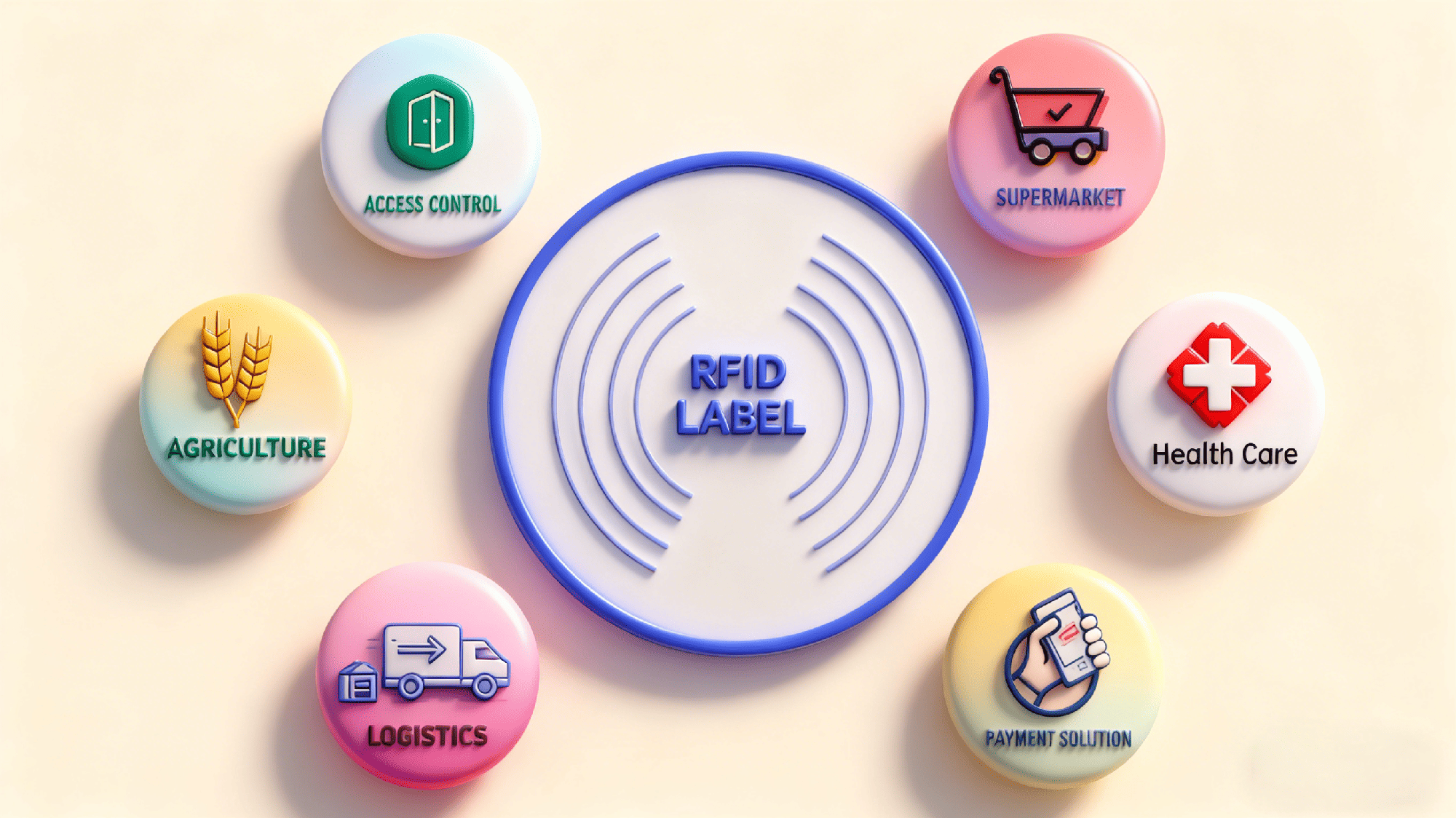
RFID labels find applications in numerous fields, including anti-counterfeiting, warehousing, logistics, retail, healthcare, transportation, and military operations. Below are several representative use cases:
Each product with an RFID label has a unique digital identity. From the manufacturing stage to retail, the entire supply chain process can be recorded and verified using an RFID reader. For consumer verification, NFC labels provide additional convenience—customers only need to tap the label with an NFC-enabled smartphone.
RFID electronic labels greatly enhance storage and inventory efficiency by offering the following features:
• Real-time cargo positioning
• Automated inventory tracking
• Faster inbound and outbound processing
This not only improves storage accuracy but also supports smart production planning.
Many leading retail brands and supermarkets are implementing RFID technology to optimize operations and reduce costs. RFID labels support:
• Improved inventory accuracy
• Optimized supplier management
• Faster checkout processes
• Enhanced customer experiences
Additionally, RFID enables the operation of smart shelves, automated replenishment systems, and loss prevention systems.
Attaching RFID labels to books simplifies the entire workflow of libraries, including:
• Faster book check-in and check-out
• Efficient stocktaking
• Automated anti-theft systems
• Reduced labor demands
This makes library operations more intelligent and user-friendly.
1.Are RFID labels more expensive than traditional barcodes?
Initially, RFID labels may have a higher upfront cost than standard barcode labels. However, the gap has narrowed significantly in recent years due to technological advancements and increased production scale. For businesses, the long-term benefits—such as reduced labor costs for inventory, fewer errors, and improved operational efficiency—often outweigh the initial price difference, especially for large-scale or high-value applications.
2.Do RFID labels pose privacy risks, as they can be read remotely?
Privacy concerns are valid, but RFID systems are designed with security measures to mitigate risks. Many RFID tags use encrypted data transmission, meaning only authorized readers with the correct decryption keys can access the information. Additionally, some “passive” RFID tags (without batteries) only transmit data when they are within the reader’s magnetic field, limiting unauthorized scanning. For consumer-facing applications (e.g., in retail), brands often disable or deactivate RFID tags once a product is purchased to protect customer privacy.
3.How long do the batteries in active RFID labels last?
The lifespan of batteries in active RFID labels depends on factors like usage frequency, transmission range, and battery capacity. Typically, most active RFID tags have a battery life of 3 to 5 years. Some high-performance models, designed for low-power operation (e.g., in logistics for long-haul shipping), can last up to 7 years. Many modern active tags also include battery-level monitoring, allowing users to replace batteries proactively before they die.
4.Can RFID labels work with existing inventory or management systems?
Yes, most RFID readers and software are designed to be compatible with existing enterprise resource planning (ERP) systems, warehouse management systems (WMS), and point-of-sale (POS) systems. Manufacturers often provide APIs (Application Programming Interfaces) or pre-built integrations to connect RFID data directly to these platforms. This means businesses don’t need to overhaul their entire infrastructure to adopt RFID—they can upgrade incrementally, reducing disruption and implementation costs.
5.What should I do if an RFID label gets damaged or stops working?
RFID labels are durable, but physical damage (e.g., tearing, exposure to extreme heat) can occasionally render them inoperable. For critical applications (e.g., warehouse tracking), it’s recommended to conduct regular checks of RFID tags during routine inventory. If a tag is damaged, replace it promptly—most RFID systems allow for easy re-registration of new tags to link them to the existing product data in the system. For passive tags (which are more affordable), having spare labels on hand simplifies quick replacements.
RFID labels have rapidly emerged as one of the most crucial tools for modern identification, traceability, and digital transformation. With their outstanding security, high speed, durability, and large data capacity, they are revolutionizing various industries—from retail and logistics to public services and anti-counterfeiting. As technology continues to evolve, the application scope of RFID labels is expected to expand even further, bringing more convenience and efficiency to global industries. The addition of robust privacy measures and improved compatibility with existing systems will only accelerate their adoption, making them a staple of smart operations worldwide.
Do you need a professional team to provide you with solutions? Contact us for a quote
Let us discuss it with you.


 Tel: +86-755-23080267
 Email: [email protected]
Add: A316,building A, Huayuan Technology And Innovation Park, Baoyuan Road
Copyright © 2024 Shenzhen ZD Technology Co., Ltd., All rights reserved.
Designed by 

